 REDTAILWORKS
OPEN-1
One synth, every firmware.
An open synth you rewrite from an SD card. Bring your own keys: plug in an FM-1 or any USB or MIDI controller, and OPEN-1 does the rest, with 16 RGB pads, touch strips, knobs, a screen and a library of firmware you swap from the menu.
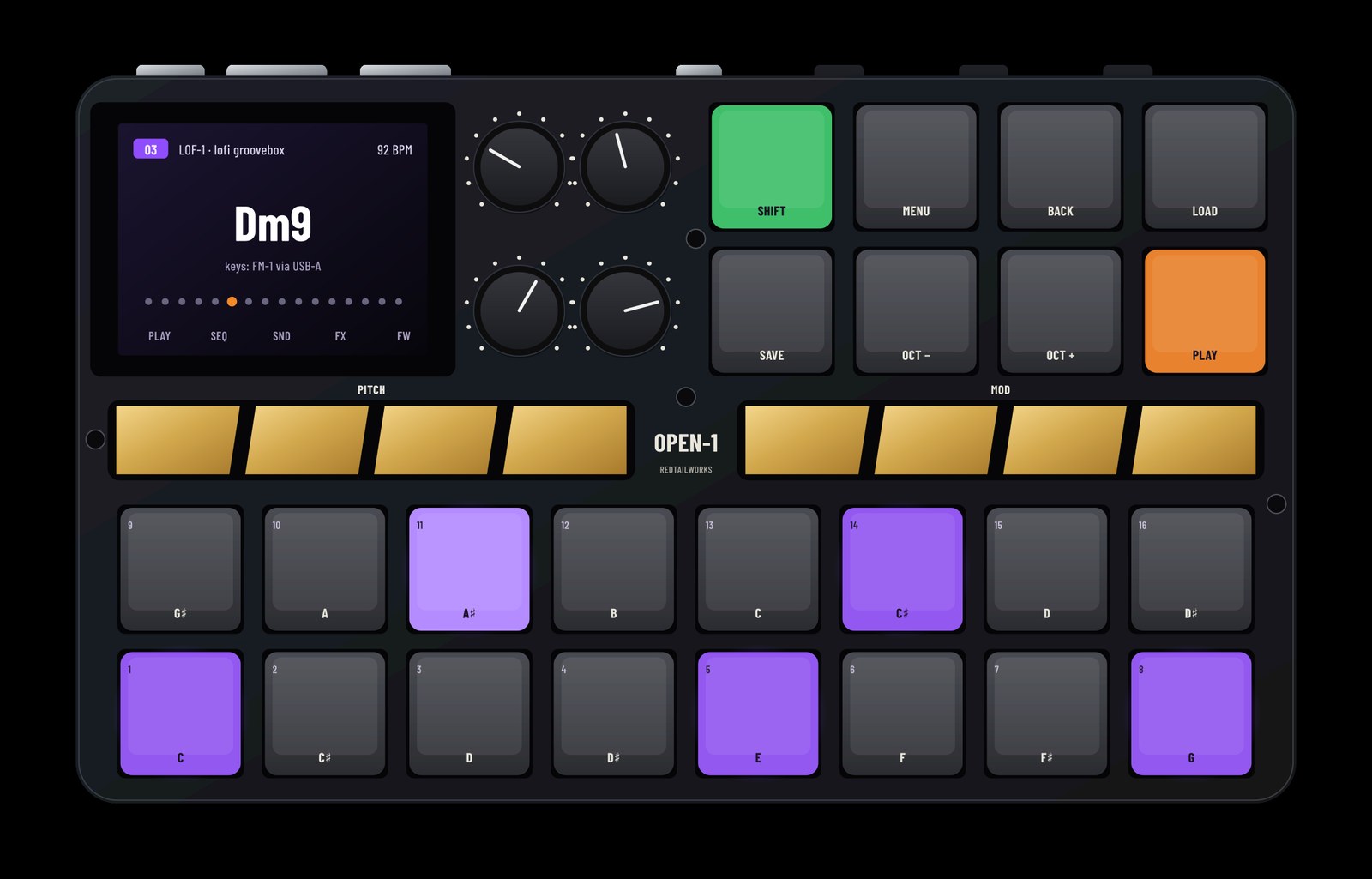
Not a product yet. OPEN-1 is a very early design I'm sharing to work out the product and test it. Nothing is for sale; the renders are design previews, and every spec and price on this page is a target, not a promise.
The latest video
Where it is now
Six phases from idea to your desk. The orange one is where OPEN-1 is today.
Idea and pitch
The spec, the parts list, drawings of the board, a pitch deck and the concept video.
DoneBreadboard prototype
A Daisy Seed (the same chip as OPEN-1) on the bench, and the beta board design in KiCad, to work out the product and test it.
NowFirst boards
The first custom circuit boards and a hand-built case, to test the real keys, pads, screen and audio.
NextEmulator, SDK and firmware jam
Developers build firmware in the browser before the hardware ships; the community votes on the pack that comes with it.
LaterCrowdfunding
Early-bird and backer pricing for the first production run.
LaterManufacturing and shipping
The first 1,000 units, with the community firmware pack preloaded.
Later
Goals
Cheap and easy to carry
No keybed to pay for: pads, sounds and effects in a box about the size of an FM-1, played from the keys you already own.
Open firmware
A documented chip, an open SDK and a free toolchain. Anyone can write firmware for it, and anyone can install it.
Many machines in one
Keep several firmwares on the device and a library on the SD card. Techno box tonight, plant simulator tomorrow.
Room to grow
Twice the clock speed and about 150 times the working memory of the FM-1, for longer delays, samples and bigger engines.
Bring your own keys
USB-A host and TRS MIDI in mean an FM-1, a MIDI keyboard or a pad controller can all play it. All the compute happens on OPEN-1.
Firmware before hardware
A browser emulator and a firmware jam before launch, so it ships with a library already full.
The beta design
The v0.4 beta design: two boards, no built-in keys. It's an early design for testing, so expect some of it to change once it's on the bench.
| OPEN-1 v0.4 | FM-1 today | |
|---|---|---|
| Processor | 480 MHz Arm Cortex-M7 (STM32H750, on a Daisy Seed) | 240 MHz |
| Working memory | 64 MB + 1 MB on the chip | About 432 KB |
| Firmware storage | 8 MB built in, plus one microSD card for firmware, samples and projects | 1 MB |
| Firmwares installed | Several, swapped from the menu | One at a time |
| Keys | Bring your own: an FM-1 or any USB or TRS MIDI controller | Built in |
| Audio | Stereo line in; stereo out and headphones, 24-bit; built-in speaker | Stereo out |
| MIDI | TRS in and out (type A), plus USB | TRS in, USB, Bluetooth |
| USB | USB-A host for your controller, USB-C for your computer and charging (one at a time) | USB-C device |
The instrument
- Keys
- None built in: plug in the keys you already own
- Pads
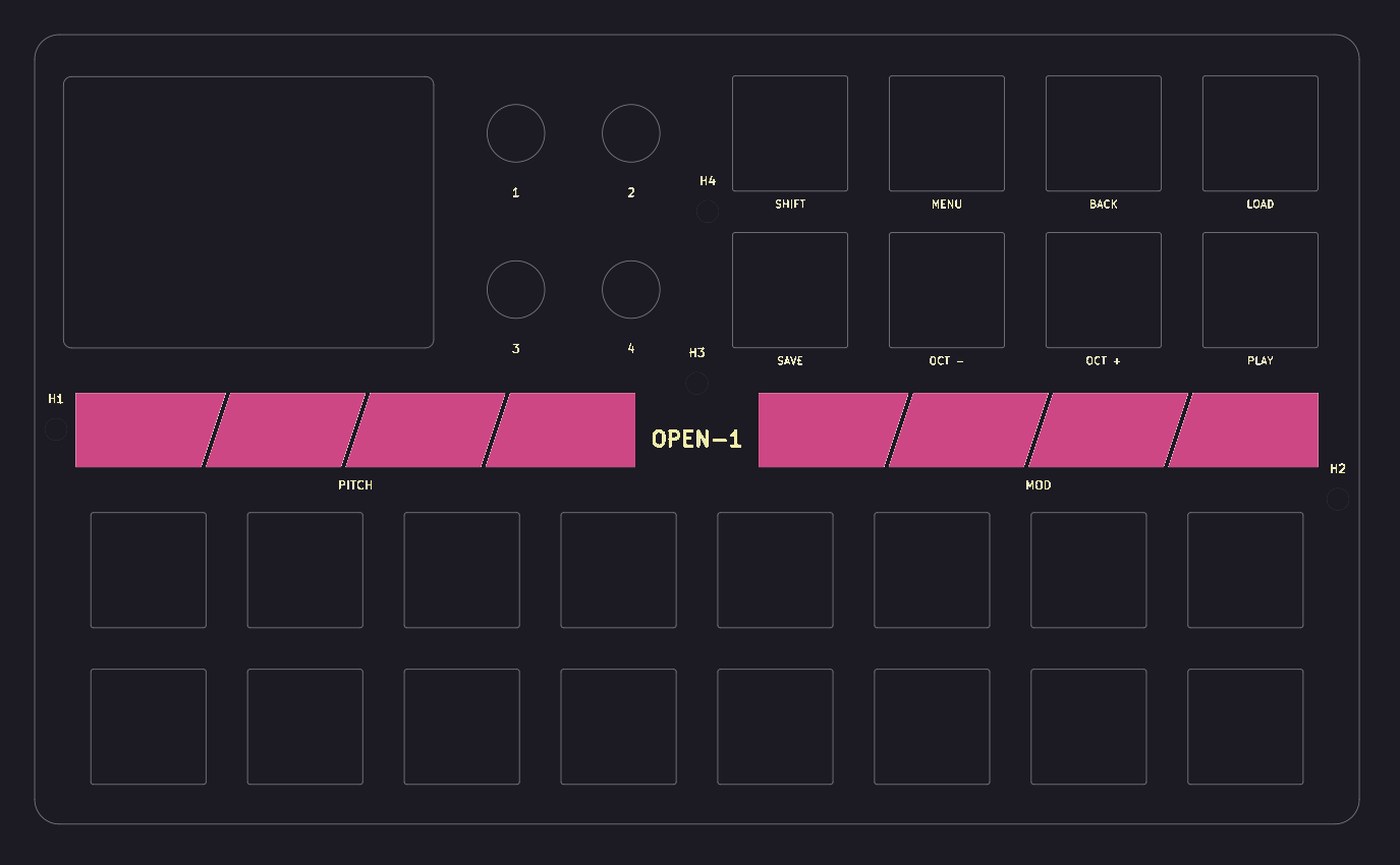
- 16 RGB pads in two rows of 8 on Cherry MX switches, so they also play as a keyboard
- Menu keys
- 8 Cherry MX keys; each firmware names them on screen
- Controls
- 4 knobs and 2 touch strips (pitch and mod by default)
- Screen
- 2.0″ colour IPS, 320 × 240
- Sound out
- Built-in speaker and a stereo out / headphones jack
- Sound in
- Stereo line in, for sampling and effects
- Power
- Rechargeable LiPo battery, charges over USB-C
- Connections
- Wired only: no Bluetooth, for low latency
- Two boards
- A main board that carries everything, and a faceplate PCB that is the switch plate and holds the touch strips
- Size
- About 161 × 96 mm, close to the FM-1's footprint, a little taller to fit Cherry MX
Price targets
The goal is an entry instrument, so the price is a design constraint from the first sketch. These targets were set for the keyboard design; the keyless beta is being re-costed and they'll be updated here.
Prices in US dollars, before tax and shipping. Estimates from the current parts list; they'll be updated here as quotes come in.
Mailing list
One email when there's real news: a working prototype, the firmware jam opening, crowdfunding dates. No spam, unsubscribe any time.
Updates
The build log, newest first.
Bring your own keys: the v0.4 beta design
OPEN-1 is out of the ideas phase and onto the bench. Here's the beta prototype design, with a new video that walks through it:
Why the keys are gone. Every earlier OPEN-1 had a keyboard built in. But almost everyone who wants an OPEN-1 already owns keys: an FM-1, a MIDI keyboard, a controller on the desk. Building another keybed into the box made it bigger and more expensive and didn't add much. So OPEN-1 is now a bring your own keys synth. Plug in your FM-1 or any USB or TRS MIDI controller, and all the sound, sequencing and firmware run on OPEN-1.
What's on the beta board
- A Daisy Seed brain: 480 MHz Cortex-M7 with 64 MB of RAM
- A 2.0″ colour screen and 4 knobs
- 16 RGB pads in two rows of 8 on Cherry MX switches, which you can also play as keys
- 8 Cherry MX menu keys
- 2 touch strips for pitch and mod, built right into the faceplate
- USB-A host for your controller, USB-C for your computer and charging, and TRS MIDI in and out
- A microSD card for firmware, samples and projects
- A battery and a built-in speaker
The schematics are done and checked, the main board is laid out for autorouting, and the faceplate (which doubles as the switch plate) is drawn in KiCad.
Very early, on purpose. This beta exists to work out the product and test it. Layouts, parts, size and price can and will change, and the specs further up this page now describe this beta design. The price targets are still from the keyboard design while I re-cost it.
I'm looking for help. If you know your way around PCB layout, embedded audio firmware (C++ on the Daisy), enclosures, or small-batch manufacturing, and you'd like to help: partners, henchmen and femboys all welcome. Come say hi in the OPEN-1 Discord.
Design 2: smaller, squarer, 16 pads
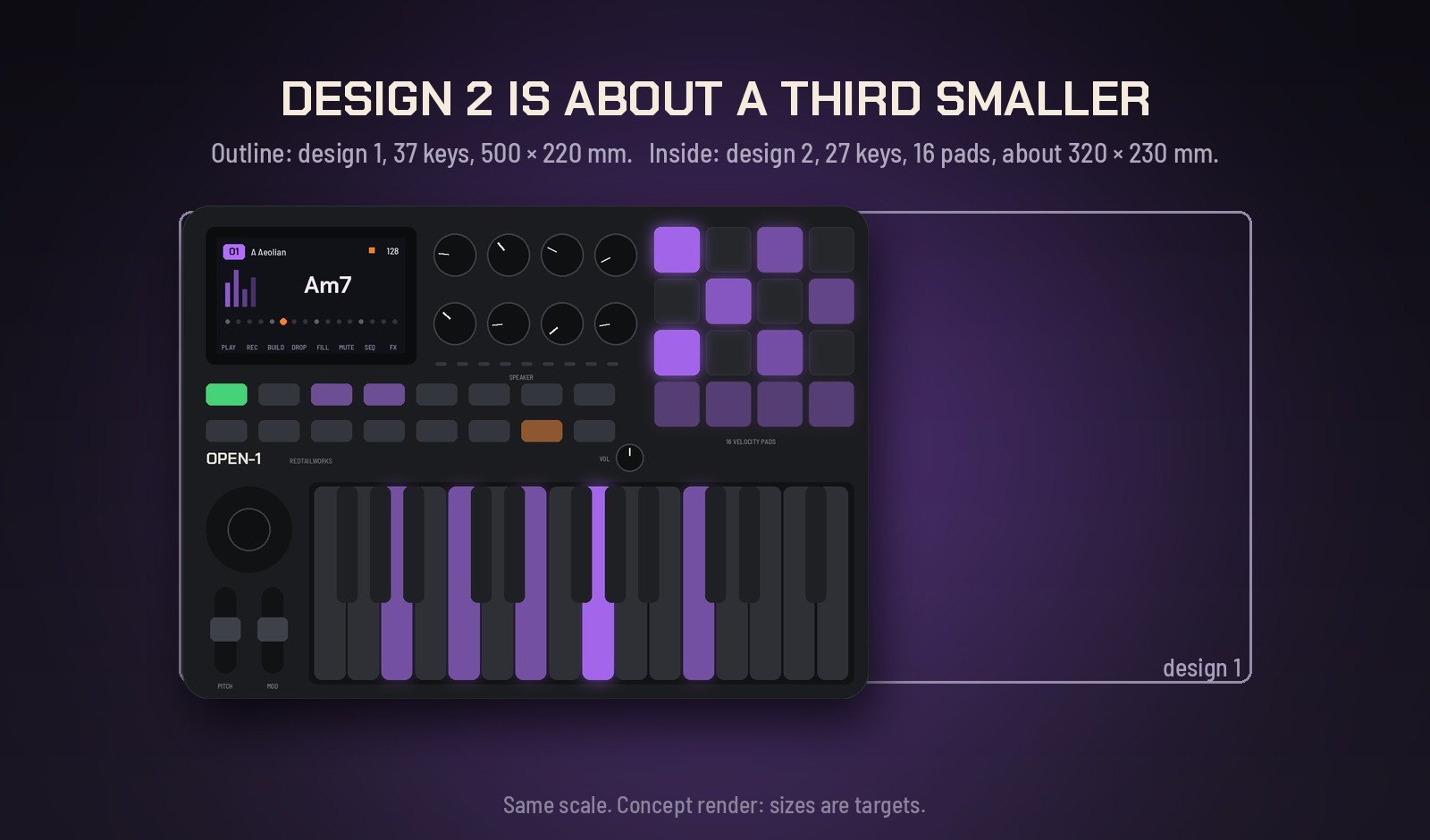
The first video got more than 50 comments in a day. Thank you, they changed the design. Here's design 2:
What changed
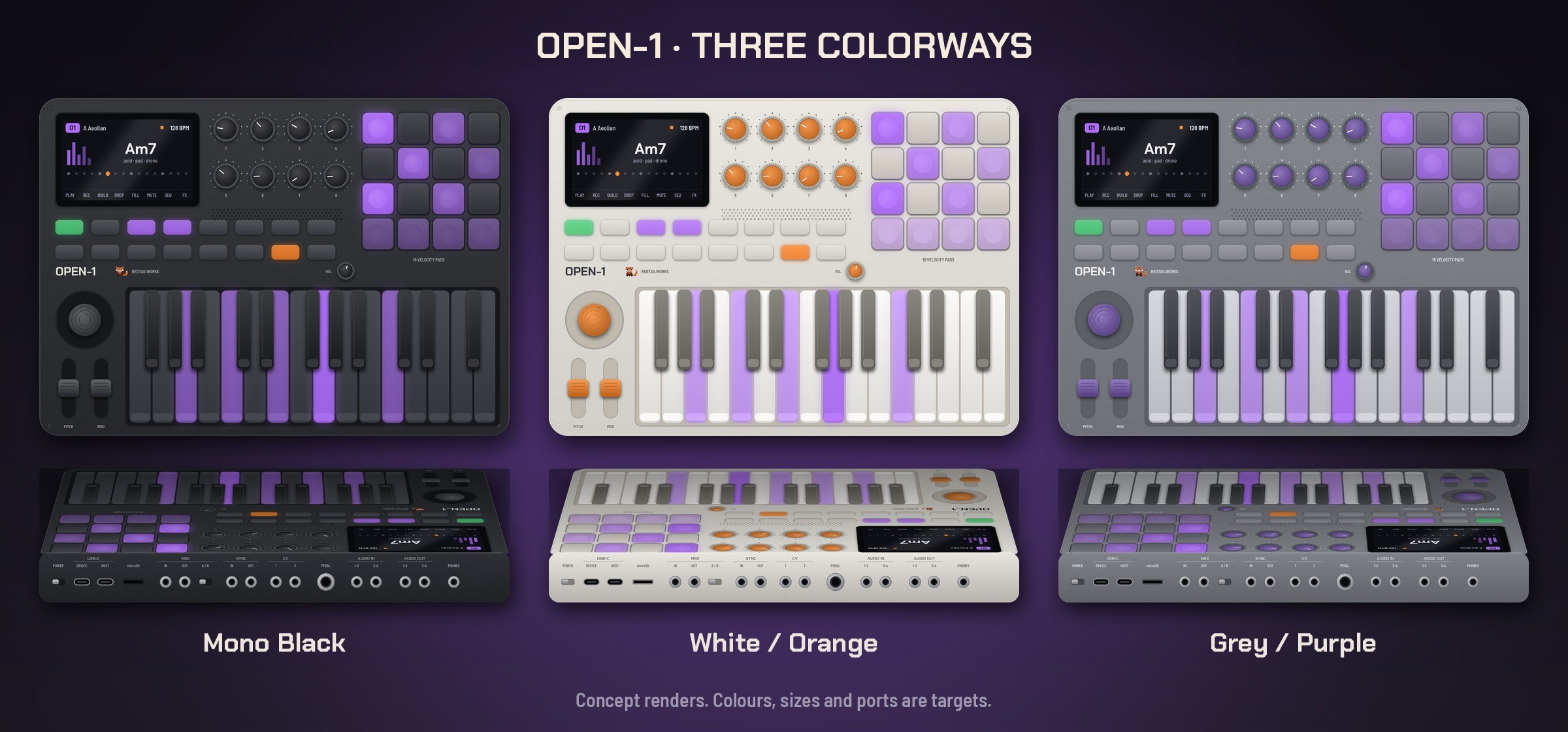
- 27 keys instead of 37. Lots of you said portability matters more than range, so OPEN-1 now has the same number of keys as the FM-1, with octave buttons for the rest. The body shrinks to about 320 × 230 mm, a third smaller and much squarer.
- 16 pads instead of 8. A 4 × 4 grid: the layout people already have muscle memory for, and 16 steps for sequencing.
- 16 lit buttons instead of 14, in two rows of 8. They have no printed names: each firmware labels them on the screen, so a button can be SAVE in one firmware and BUILD in another.
- Push encoders. All 8 encoders now click, so one of them can be the menu button.
Ten fewer keys and a smaller case should roughly pay for the extra pads and buttons, so the target price stays under $200. The number of RGB LEDs stays at 59.
What stays, and why
- Silicone keys. I read every comment asking for a better keybed. Silicone keys are a big part of keeping OPEN-1 cheap, and a low price is half the point of the project, so they stay. A premium version with a real keybed could come later if the first one does well.
- The thumbstick, not a touch pad. A stick is cheaper, sturdier, and simpler for firmware writers to use.
Still on the table. Tell me which of these you'd actually use: a sustain pedal jack, sync in and out, a switch for TRS MIDI type A or B, or CV and gate outputs for modular gear.
How it compares to the SMK-37. The M-VAVE SMK-37 is a great keyboard, and it runs some of the same custom firmware as the FM-1. But it has the same processor and memory limits as the FM-1. OPEN-1 is about headroom: about 75 times the working memory, audio in for sampling and effects, several firmwares stored at once, and a well-documented chip with a standard toolchain.
Every connection you asked for, and one SD card for everything
The comments asked for more ways in and out, so the back edge now has them:
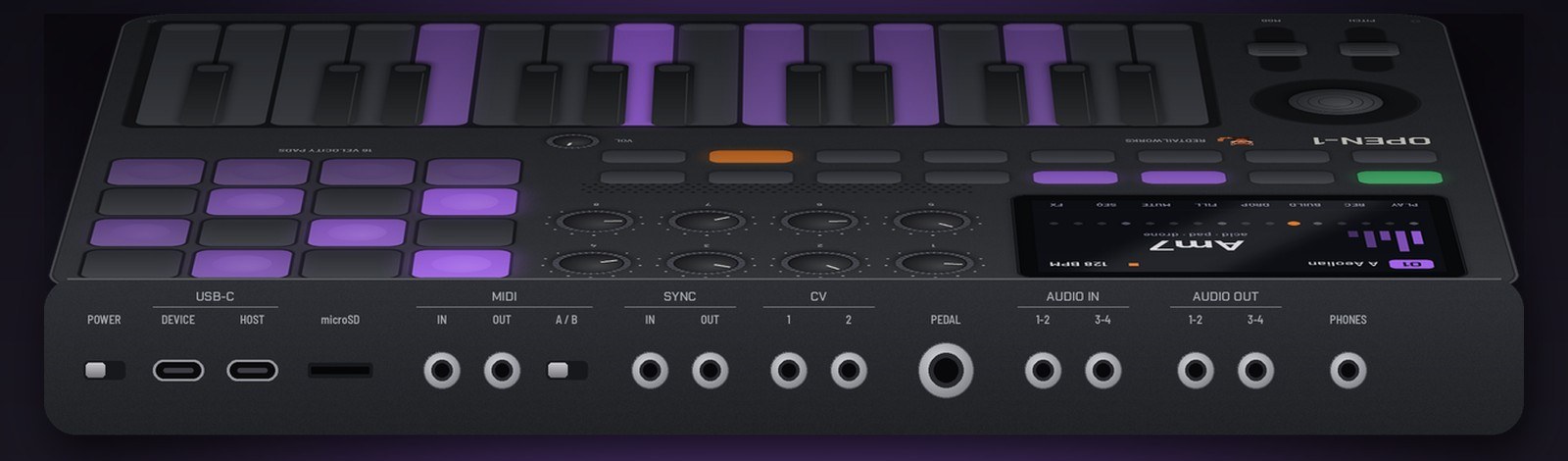
- 4 audio inputs and 4 outputs, 24-bit, from a second audio chip. Plugged into a computer, OPEN-1 is also a 4 × 4 USB audio interface.
- MIDI in and out on 3.5 mm TRS, with an A/B switch so either cable standard works, plus MIDI over USB.
- Sync in and out, at whatever clock rate the firmware sets.
- 2 CV outputs (0–5 V) for modular and older gear. With sync out as a gate, that's three CV/gate outputs.
- A pedal jack for a sustain or expression pedal.
- USB-C host for keyboards, controllers and thumb drives.
One SD card holds everything: firmware, samples and projects, in one folder per firmware. The firmwares you use most also sit in 16 MB of built-in storage, so OPEN-1 starts without a card. The chip also has a factory recovery mode in its ROM, so it can't be bricked: USB repair always works.
The extra jacks and the second audio chip add about $4 a unit, so the parts cost is now about $73, and the price targets don't change.
Two things I cut to keep the price down
Bluetooth is out. OPEN-1 connects by USB-C and MIDI cables only. Wired MIDI has lower and steadier latency, there's no radio to certify, and the money goes into the audio input and the MIDI output instead.
The keys have no velocity. They're silicone keys like the FM-1's, each lit by its own colour LED. That's cheaper and quicker to build than a velocity-sensing keybed. The 8 pads keep velocity, and a firmware can turn one of the spring levers into a velocity control if it wants one.
Both changes help OPEN-1 stay under $200 without giving up the things that make it more than an FM-1.
OPEN-1 is an idea, and here it is
Four firmwares into the M-VAVE FM-1, I keep running into the same walls: 1 MB of flash, about 432 KB of memory, no audio input and one firmware at a time. OPEN-1 is what I'd build to get past them.
It's an open, entry-level synth: 37 keys, pads, knobs, a bigger screen, and a microSD card full of firmware you can swap from the menu. The plan is to keep it under $200 and open it to firmware developers before it ships.
What exists today:
- A full target spec and parts list, with the parts priced at 1,000 units
- Drawings of the front panel and a block diagram, plus a first sketch of the circuit board
- A pitch deck for manufacturers and backers
- The concept video above, with OPEN-1 running a simulated HYP-1
What doesn't exist yet: hardware. Nothing here is for sale, and every spec and price is a target.
Next: a breadboard prototype on a Daisy Seed, which uses the same chip, so HYP-1 can run on the real processor.
If you want to follow along, join the list below. If you'd like to help fund the prototype, Ko-fi is the place for now.
Follow in a feed reader: RSS
Want to help it happen? Ko-fi tips fund the breadboard prototype and keep the free FM-1 firmware coming. For partnerships, manufacturing or firmware, email me.
itsme@redtail.worksEmail